A new initative has recently begun in Sligo. Open Door Sligo appears quite covert, mainly because their facebook page is updated sporadically. The idea is similar to the Open Doors weekend, building of historical significance are opened to the public for an afternoon.
Advance booking is necessary, as space can be limited in some of these buildings. Open Door Sligo had co-ordinated a tour of Sligo's Masonic Lodge last year, and I was disappointed to have missed out, but now I had my chance! Masonic Lodges have always been a source of fascination to most people. Unlike churches and places of worship they remain closed places, accessible only to those who are members of the mysterious brotherhood. Some famous (and unexpected) Freemasons include Oscar Wilde, Clark Gable, Robert Burns, Walter Scott and Peter Sellers.


When we were all seated in the meeting room (where certain decorative features are modelled after the Temple of Solomon), we were given an overview of the Freemasons, and its history in Ireland, by Morgan McCreadie. Morgan is the assistant to the grand secretary of the Irish Freemasons. I had encountered Morgan before, when he spoke at the last Trailblaze event at Dublin's Masonic Temple. He is a most engaging and charismatic individual, and he did succeed in dispelling some popular myth around the Freemasons. In fact just yesterday he was featured in an Irish Times article on the subject of Freemasonry.
The house itself is in a state of disrepair, and relies on donations from members to fund repairs. You could say that the house was lacking a "woman's touch", as a few odds and ends were scattered untidily among the photos and paraphernalia. Freemasons meetings are first recorded in Sligo as far back as December 1760, but it wasn't until 1895, after years of tireless fundraising, that a purpose built meeting place was built in Sligo town. Jack and William Butler Yeats maternal grandfather, William Pollexfen was a member of the Sligo Freemasons Guild.
The Masonic Square and Compass, seen here on the front gate, and the clock on the mantlepiece, are recognisable as architect's tools and are used in Masonic ritual as emblems to teach symbolic lessons. No hierarchy exists in the guild, Morgan assured us, these are working men, and these tools allude to that, to the honesty and morality of their work. Freemason's meetings are ritualistic, which sounds somewhat hocus pocus, but really means that they follow a format that has changed since the formation of the brotherhood, which has become ritual.


There are currently 25,000 Freemasons in Ireland today. The Masonic Temple on Molesworth Street is open to the public, within working hours. The Freemasons discretely donate sums of money to various charities, something that is neglected to be mentioned in the press, further enveloping these societies in secrecy.
The elephant in the room, was the question of why women were still excluded from membership. Morgan gave us a simple, straight forward answer, the subtleties of which escape me now. Essentially, men need a place to gather with their fellow man, in an all male environment, men interact differently than in a mixed environment. Women behave differently together, they are multi-taskers, they make plans, men prefer to relax, knowing what to expect, or something to that effect. I was satisfied with his explanation, I have no desire to become part of the organisation, though now some of the secrecy has been removed, it's not as elusive to me as it once was.
Elements of their ritual still fascinate me, as the 'Freemasonry' wiki states "Freemasons use signs (gestures), grips or tokens (handshakes), and words to gain admission to meetings and identify legitimate visitors.", well this myth does hold true, as confirmed by Morgan.
All in all, an afternoon well spent! I'm thrilled to see initiatives like this taking place (this one was hosted by the Sligo Peace and Reconciliation Partnership, which aims to strengthen cross-border relations), arts and culture are underappreciated at local government level, are usually under funded if at all, if the turnout for this event is anything to go by, its doing something worthwhile.
Find out about future Open Door Sligo events via their facebook page.
-
Read more: Deconstructing a few secrets of the Freemasons (The Irish Times, April 30th 2013)
Of the two main beaches in Sligo, Rosses Point is the closest to where I live. It is referenced in W.B. Yeats poem The Stolen Child, and one stanza in particular comes to mind whenever I go for a walk here:


(Click images to enlarge)
Where the wave of moonlight glosses
The dim gray sands with light,
Far off by furthest Rosses
We foot it all the night,
Weaving olden dances
Mingling hands and mingling glances
Till the moon has taken flight;
To and fro we leap
And chase the frothy bubbles,
While the world is full of troubles
And anxious in its sleep.
Come away, O human child!
To the waters and the wild
With a faery, hand in hand,
For the world's more full of weeping than you can understand
In the summer when the sun does make an appearance, Rosses Point was my preferred beach for sun lounging. The sea here is much calmer, and if you walk to the end you can see Lissadell House across the bay. I remember when I was working at the Leonard Cohen concert in 2010, in the evening just looking across the water to see Rosses Point glowing in the moonlight, with Cohen's husky voice providing the backdrop to a memorable midsummer's evening.
Less bustling than Strandhill, it is more popular with dog walkers than surfers. The romantic in me endears me to Rosses Point, and I find it very restful sitting on a bench among the sand dunes when I feel like having some headspace. Maybe Yeats did the same. The artistic and mystic poet George 'Æ' Russell said to have witnessed mystical visions here on one of his summer visits with Willy Yeats. I'm not so sure about that, but Sligo can be magic, if you allow it to be.

Photo by Denise
Sligo is surprising. It's a surfer's paradise with its sandy beaches, on the cusp of the Atlantic sea, all those waves. The only thing that's missing from this paradise is the sun that puts in an occasional appearance.
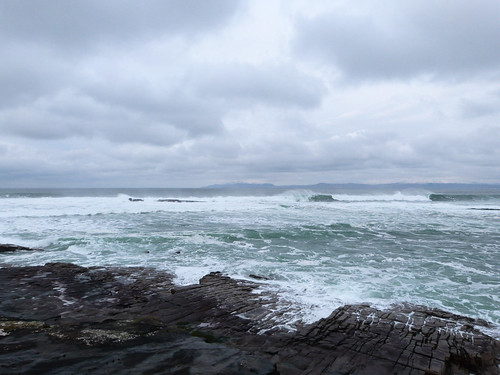
A couple of weeks ago, Denise informed me that Billabong's Tow In Session was taking place. International surfers ("wavehunters") travelled from around the globe at mere days notice to surf the big waves. I had known that 'tow surfing' (getting towed out further to enable surfers to ride bigger waves than they'd normally be able to paddle out to) was a thing off Mullaghmore Head (in North County Sligo), but I'd never witnessed it for myself. I dressed in my most sensible woolens, my winter coat, packed a thermos and she picked me up and we headed out.


The biggest waves in Europe, measuring 40-50 foot high had until this year had been surfed off Mullaghmore Head by an Irish surfer in 2010. The day we went out there (January 23rd) groups of onlookers had gathered to watch the waves and the surfers in the blustering wind. The waves seemed to me to be almost like something out of a film. When you stand at Mullaghmore Head you are confronted with the awesome power and force of the sea. I get an adrenaline rush just standing there, thinking of the restlessness of the sea, and how nothing but the unpredictable Atlantic is between you and America.

Ooops, I forgot to bring gloves!
I was mostly too absorbed anticipating the waves to take many photographs, and these are a poor reflection of the mood out there that day. The surfing community is an international one, they're all there for a common goal, there's an etiquette to surfing, that you won't find in many team sports. The community is very pro-active, there are extreme surfing photographers and surfers who capture incredible footage to distribute and share with the international surfing community. In these cases, capturing these moments on film aren't simply for personal preservation, but as visual proof for competition judges, but they're also enjoyed by surfing enthusiasts and curious folk such as myself (I had a brief fling with surfing when I was 16, and haven't been involved since).
This is what was taking place a couple of weeks ago, in my backyard (in a sense):

Classiebawn Castle, with a snowy Ben Bulben providing a winter backdrop, January 2013

At Classiebawn Castle, December 2012
As you drive along the coastal road of Mullaghmore Head, Classiebawn Castle with Ben Bulben in the background comes into view. I always have to get out of the car for a few moments to admire my favourite view in the world.
Despite being in London for only a few days, I'm a country girl and it was a relief to get out of the city for an afternoon. Having studied the arts and crafts movement, and with an interest in historic interiors I decided to catch the train out to Bexleyheath to visit William Morris' Red House.
After about 45 minutes on the train from Victoria I arrived at my destination. I was a bit worried that it would be out of the way, hidden in a housing estate, but my google map wasn't necessary in the end as the directions were very well sign posted (its the National Trust we're dealing with here!) once you walk out of the station.
The house is owned by the National Trust, and is in a constant state of conservation. While I was there, they were still working on unearthing original wallpaper and murals.


Philip Webb water glasses, designed for use at Red House. A recent acquisition, these were found by an eagle eyed individual on eBay!

Panel by Edward Burne-Jones, originally placed in the front door of Red House, the painted glass surrounding it is by William Morris.


One of my favourite features of the house was in the garden hallway, the owner of the house in the 1890s had used the glass panels of the door as a visitors book, for guests to etch their name into the glass. The names of Arthur Lasenby Liberty, May Morris and Georgiana Burne-Jones can be made out (only May's is visible on this panel on the bottom, it was too dark and my pictures didn't turn out well)! There's something about a persons handwriting that makes a figure from history seem more authentic somehow.

Morris fancied himself the Medieval Lord of his Manor. He would have a large oak table erected in the hall here, when he had guests to dinner. This (unfinished) settle in the hallway was painted by Morris and the Burne-Jones. The left hand panel is painted rather amateurishly by Morris, focusing mostly on decoration and embelishment, the panel to the right was painted by the Burne-Joneses. A quirky detail is of the woman on the far left of the left hand panel, it is a depiction of the Morris family's housekeeper, at Red Lion square!


This is one of 7 surviving embroideries from a scheme of 12 envisioned for the dining room at Red House. This panel depicts Aphrodite, and turned up in an auction in Edinburgh in 2007. Out of the remaining six, 3 can be found at Kelmscott Manor, and 3 at Castle Howard (the only ones with embroidered backgrounds). I had the privlege of seeing the Castle Howard ones on my visit there in early 2011, and they are currently on display as part of the Tate's Pre-Raphaelite exhibition.

The drawing room, with settle designed by Morris. This room had an elaborate decorative scheme with the wall painted in murals by Jane and William Morris. This, and the settle was painted over with white emulsion paint in the 1950s and is slowly being uncovered by conservators.

This 'Minstrels Gallery' was added by Webb in 1859 and probably made for a romantic nook for visiting guests!


The walls on either side of the settle are painted by Edward and Georgina Burne-Jones as their wedding present to the Morris couple. They depict The Wedding Tale of Sir Degrevant.

(Photo source)
Recently, a mural believed to be painted by Elizabeth Siddal as she recuperated at the house shortly before her death, was uncovered hidden behind a wardrobe. This is a fragment of the mural scheme, it is currently being restored, as you can see its in quite a bad state of deterioration. This was painted in William and Jane's bedroom, where a sunflower scheme is being uncovered on the ceiling and walls.

This pattern "Kelmscott Tree" found on the Morris Bed at Kelmscott Manor, currently at the Tate Britain Pre-Raphaelite exhibition. The bed pelmet, in this pattern, was designed by May Morris, and embroidered by Lily Yeats and Ellen Wright (1891-3).

These blocks would have been used by Morris & Co. to screenprint their patterns onto paper, some of the more intricate patterns would have required many of these, resulting in a more costly design.

While in Red House, Morris designed his first three patterns for Morris & Co.; Trellis, Daisy and Fruit (Pomegranate). These were inspired by the flora and fauna surrounding Red House.

These famous round windows feature in the upstairs hallway. The glass is handpainted by Morris in a medieval pattern featuring his motto Si Je Puis ("If I Can").

The view of the back of the house.
In 1865, due to financial and work commitments, Morris had to sacrifice his house of dreams.

May Morris would only have been a child when they left in 1865, this photograph may well have been taken in the interior of Red House.


These photos, were taken in 1865, the year the Morris family moved out of Red House. Taken by Robert Parsons and styled by Rossetti (they were taken in his garden) they were to inspire the Pre-Raphaelite inclination in art as well as photography.
-
It seems hard to imagine now, that this once was positively rural, and now its just another suburb of London. All these estates have popped up around Red House, which still has the luxury of its garden. The houses all vary in age and style. I noticed that some of the earliest houses dated from 1876, when Morris' house was completed in 1860, 16 years before these houses were erected. Possibly the closest houses at the time?
As always you can click on the photos to enlarge them.
**Also this is a great video, featuring reknowned Pre-Raphaelite academic Jan Marsh, talking about Red House.
You can get the train from Charing Cross or Victoria station to Bexleyheath. Admission is £8 for adults, there is no student rate. The house is decorated for the Christmas!
I’ve dreamt in my life dreams that have stayed with me ever after, and changed my ideas; they’ve gone through and through me, like wine through water, and altered the colour of my mind. Wuthering Heights, Emily Brontë (1818-48).
I wasn't sure what to expect when I was planning my visit to Haworth, in the Worth Valley, home of the Brontë sisters. I kept my expectations low, dreaming only of the moors that surrounded this place. My traveling companion was another Zoë!


The village of Haworth itself, capitalises on the legacy of the sisters, the last of whom, Charlotte (1816-55), died in 1855. There are Brontë B&Bs, tea rooms, holiday homes, taxi cabs... and so on. There was an excess of gift shops (and old-fashioned sweet shops) selling bunting, hand made jewellery and crafts and Cath Kidston, and those shabby-chic-vintage-oh-remember-the-war! type trinkets that glorify the era of that tired old slogan "Keep Calm and Carry On". These are typically aimed towards the American and Japanese tourists, who make up the majority of visitors ever year. (The village attracts around 75,000 tourists a year, this peaked in the 1970s when it was 250,000 per year!)
The old apothecary where Branwell Brontë (1817-48) purchased the fatal laudanum that he was to die from an overdose of is now run by Rose & Co., a successful British traditional skin-care company based in Haworth. We did spend the best part of an hour oogling the indulgent beauty treats and admiring the shop's collection of vintage beauty packaging, on display below the original glass fronted counter. Many of the shops in the village maintain a "cultivated quaintness", but for me, that's a by-product, I'm not so bothered by it as the locals are entitled to make money to pay their bills.

The famous iron sign that hangs outside the Parsonage, was designed in the 1940s by Mr Mitchell, one of the first curators of the Brontë Parsonage Museum.

"Everything fits into, and is in harmony with, the idea of a country paronage, possessed by people of very moderate means." (Elizabeth Gaskell, novelist and biographer of Charlotte, commenting on the parsonage in a letter to a friend)

The Parsonage is situated by the church and graveyard. In the Brontë's time, the average life expectancy in the village was 25. This influx of bodies into the overcrowded graveyard in turn poisoned the village's water system. It was their father, Patrick Brontë who planted the trees which now surround the house, to accelerate the decomposition of the bodies laid there. Its a sobering thought, the Brontë's truly were surrounded by the apparition of death throughout their lives.

This bronze statue of the Brontë sisters by Jocelyn Horner is in the Heather Garden of the Parsonage, you see it as you pass through to the gift shop (which is particularly well stocked by the way)
We had dinner on the first night in the Old White Lion, founded in the 18th century. Our meal was in the Gimmerton Room which gave me a twinge of excitement! The interior is delightly welcoming and modern, without being contemporary.
The next day before a failed trip to the moors, after seeing the Parsonage, we ate in the quirky café Cobbles and Clay. The menu was extensive, the soups and cakes delicious, and everything is marked as being gluten free, or whether or not its suitable for vegetarians and vegans.
On the morning of our departure we had a baked potato (some honest Northen grub!) in the unpretencious Villette tearooms, having spent the best part of the morning strolling up and down the main street of Haworth, we took ourselves and the books we purchased in Venables and Bainbridge Books, to the 10 The Coffee House, where I had the most divine hot chocolate and homemade biscotti. The hot chocolate I was told was a secret recipe, alas, so I must try and experiment myself. 10 also functions as a B&B, with its refreshing elegant period interior its certainly something I would consider on my next inevitable visit.

The shop owners of Haworth village owe a pun or two to the village's famous daughters.


This charming bookshop had an especially inviting window display, but alas it was closed. Haworth experiences a tourist decline in the winter so some of the shops only open on certain days. I really fancied getting that mug!


Village politics


The unique nature of the village means there are a lot of twee homewares, curiosity shops selling "Yorkshire relics" and posters for "wartime balls".
You weren't allowed to take pictures inside the house, and I wouldn't have done it justice anyway, but you can view some images in this flickr set here, or get a virtual tour on the offical website.

Token photo of me in front of the Parsonage entrance
It was chilling to stand in the doorway of the sitting room, where the three sisters sat around the table and penned their novels. To look upon the sofa where Emily drew her last breath, in denial of her illness until the end. To think of Charlotte pacing this room, alone, for eight years after her siblings deaths. When you're in the upstairs rooms, looking at Charlotte's pint sized dress and wedding bonnet, you might hear the chime of the clock on the stairs, which Rev. Patrick Brontë would set every night before ascending the stairs to his bedroom, after calling upon his daughters to tell them to get along to bed!

A little and a lone green lane
That opened on a common wide;
A distant, dreamy, dim blue chain
Of mountains circling every side. (Emily Brontë)
The museum is independently run, changes its exhibitions frequently and the Parsonage guidebook was wonderfully informative, as well as being great value. £7.50 for the guide and a guide to the Brontëana exhibit, which is at the end of the house tour. There's all manner of memorabili relating to the family. Scraps of their dresses, handwritten letters, a mourning locket containing Charlottes hair, the famous family juvenilia: those mininature books created about the fictional Gondal when they were children, and on a more sombre note, funerary cards and a sketch by Branwell depicting the spectre of death by his bed, waiting to steal him away, the last known work of his, death did catch up with him only months later.

Portrait of Anne, Emily and Charlotte by Branwell, now on display in the National Gallery
A reproduction of the famous portrait by Branwell of his sisters looks upon you as you make your way up the stairs. I was lucky enough to see the original in the National Portrait Gallery before my trip up North. It was found by the second wife of Charlotte's husband, folded on top of a wardrobe.

After my visit I feel invigorated. Clichéd as it may be, having walked the well trodden cobbles that the sisters once walked, I feel a deeper connection with their writing. Somethings changed. I felt the same wind in my hair, the same rain on my skin, the same biting cold. Charlotte spoke of her sadness in walking the moors after her sisters deaths. Emily was in the landscape all around her. Everything was changed utterly. Over 150 years have passed, the world is changed, I had to look harder, and undeniably I was seeing it through rose tinted glasses, but when I closed my eyes I could feel the other worldly mood that hung over that village. My visit shook me up and brought me to the realisation that I don't know half as much as I want to! The sisters were talented artists, writers, craftswomen and knew about maintaining domestic comforts, as was expected of women of their rank.

The headstone from the 1992 film adaption of Wuthering Heights. A toungue in cheek piece of memorabilia also on display in the museum. My favourite adaption!
I plan to join the Brontë Society and on my return to Haworth, whenever that may be, and walk to Top Withens (the inspiration for Wuthering Heights) and Ponden Kirk (Penistone Crags).
Lets not forget that Sylvia Plath's grave at Heptonstall, is close by, as Maeve helpfully informed me!
If you find the idea of Haworth compelling read these three articles, come to your own conclusions. Keep the magic of fantasy alive, or make the pilgrimage? You decide.
Life on Moors (New York Times)
Mad about the Brontes (Jolien Janzing)
The Brontës are alive and unwell in Haworth (Sam Jordison)
The Bronte Parsonage blog is updated regularly.
We stayed in a rather eclectic B&B called Ye Sleeping House, which was a bit overwhelming but an experience in itself: