Tread Softly... A Season of Yeats, is an annual 10 day festival running alongside and complementing the Yeats International Summer School, focusing on the connections between Sligo and Yeats through a programme of music, exhibitions and spoken word performances.
The Tread Softly festival is an initative that seeks to promote Sligo's Yeats legacy as a unique cultural visitor attraction. "The Land of Heart's Desire" has long held appeal for devotees of the poet Yeats, but the story of the Yeats family has its roots in Sligo's rich landscape.
The short video above shows the highlights of last year's first 'Tread Softly' festival. From 2:45 onward you can hear me speak! Last year I gave tours of the John and Jack B. Yeats 'Father and Son' exhibition at The Model gallery. This year I will again be giving a couple of public tours of the current Jack B. Yeats' exhibition 'Enter the Clowns: The Circus as Metaphor'.
Though not a new concept by any means, cultural tourism has gained a lot of mileage in recent years, particularly amongst regional tourism groups striving to make economic gains by utilising their unique local cultural heritage. And who can blame them? Personally, I have seen a vibrant revival in Sligo's arts and culture scene, since I returned a little over a year ago (after being abroad for almost 2 years). Much progress has been made to promote Sligo as a cultural destination, for the benefit of its locals and visitors alike. Cultural tourism also takes place at a local level, with the advent of facebook, many groups promoting local history and encouraging engagement from their members have sprung up. Some recent festivals promoting their area's unique cultural attractions include the Liberties Festival and Happy Days - Enniskillen's International Beckett Festival.
What is Cultural Tourism? Cultural tourism is about understanding the collective cultural offer of a destination, matching that offer to (and connecting with) the 'wraparound' industries (food, drink, hotels, shops and so on) and making sure that it's all packaged in a way that is meaningful to the consumer. (Helen Palmer, 'Why cultural tourism is not a quick fix', The Guardian, April 15 2013)

Recently, in acknowledgement of this, the North-West Craftfest was rebranded as the Lily Lolly Craft Fest. The aim is to commemorate the legacy of the lesser celebrated Yeats sisters, who were pioneering craftswomen in their own right. They were at the forefront of the Irish Arts and Crafts movement, founding the Dun Emer Guild in 1902 with Evelyn Gleeson in Dundrum, Co. Dublin. You can read the article I wrote on the sisters for the Women's Museum of Ireland here.


1. Martina Hamilton, owner and designer at the Cat and the Moon craft boutique and jewellery shop, and curator of the Hamilton Gallery, officially launching the Lily Lolly Craftfest on June 13th.
2. Celebrated academic and expert on the Irish arts and crafts movement, Nicola Gordon-Bowe, delivering a talk on the legacy of the Yeats' sisters, at the Lily Lolly Fest.
The Lily Lolly Craft fest coincided with Yeats Day 2013. Yeats Day is envisioned to be Sligo's version of Bloomsday (June 16th) or Shakespeare's Birthday (April 20th).These are grand shoes to fill. Expectations are hig. The Lily and Lolly festival had the support of local businesses and crafts people. My festival highlights include the Nicola Gordon-Bowe lecture, Una Burke's talk and an embroidery workshop with Amy O'Hara of Dumore Embroidery. These events certainly played close to the Lily and Lolly legacy, by promoting a body of work by by local craftswomen, and the festival was launched with a talk by Nicola Gordon-Bowe, an authority on the Yeats sisters.

My criticism would lie with the marketing of these events, particularly the digital strategy. While the leaflets and poster designs were of particularly high quality. There appeared to very little engagement with Sligo's online community, or the online craft community at large. Una Burke's talk was a total revelation to me, but was so poorly marketed that the attendance for what was an outstanding afternoon was less than it should have been. This lady's career is on the rise, she has designed for Lady Gaga and has exhibited in prominent London galleries! Her inclusion in the event line-up should have been shouted from the rooftops, at least the virtual ones! The failure of the digital strategy to provide a suitable platform for the local businesses that participated meant that some events didn't receive as much attention as they might have done. In this globalised world, cultural organisations cannot afford to ignore the digital sphere when working in cultural tourism.

Looking at organisations finding their soft spot in engaging the cultural and digital sphere ... one of the more unique places I have gone to see a performance, Sligo's Blue Raincoats Theatre company staged a performance of W.B. Yeats' play Purgatory at the summit of Knocknerea mountain, at the base of Queen Maeve's cairn. Incentives like this promote Sligo as a unique cultural destination, a place where magical things happen, such as a contemporary theatre company staging a play by one of the counties famous sons, at the summit of an ancient mountain.

The 'Sligo Who Knew?' campaign turns to social media to unearth the counties hidden gems and to promote Sligo as a 'staycation' destination, being only a 2 and a half hours drive from Dublin. Using the #sligowhoknew hashtag Sligo businesses, cultural centres, selected digital ambassadors, tourists and Sligo tweeters can share the hidden corners of Sligo, from their unique point of view! You can see all the tagged content from all social networks on the #sligowhoknew tagboard. It is probably one of the most forward thinking digital tourism strategies in Ireland at the moment! As a Sligo person, I too play a part in this dialogue, as the press release highlights - "Locals Become Proud Ambassadors of their Homeland".
"… Sligo was a different habitation. A small and beautiful town situated almost at the western edge of Europe, it was bounded by green fields, mountains, and the sea, and its narow streets were lined with small shops. At the quays there were boats loading and unloading, and sailors with stories that made the world seem “full of monsters and marvels”. Over the town to the west loomed the mountain Knocknarea, on its flat top an enormous mound supposed to contain the remains of Queen Maeve; to the north beyond Drumcliff stood Ben Bulben, the long stone outcrop ending in a massive, razor-sharp edge. With its mists and changing colours, its ancient mysterious mounds and dolmens, Sligo was a place where one could easily believe in a world of magic.”
'Prodigal Father: The Life of John Butler Yeats (1839-1922)', William M. Murphy,
(London: Cornell University Press, 1978)
Sligo and its enchanting landscape was a constant source of inspiration for all of the Yeats siblings. Prompted by their father's inability to secure and retain commissions they entered into artistic professions with the intention of earning a living, with the explicit aim of utilising their creative talent into something productive and profitable. These recent festivals promote the Yeats family legacy and seek to place it at the centre of the cultural, historical and physical spirit of Sligo, inspiring a new generation to be inspired by Sligo and its creative traditions; just as the Yeats family once were.
See more:
Cultural Tourism Ireland
Museums connecting cultural tourists: more substance over style, please
Helen Palmer, 'Why cultural tourism is not a quick fix', The Guardian, April 15 2013
‘Sligo – Who Knew?’ Turns To Social Media To Unearth Hidden Gems
Tread Softly ... A Season of Yeats festival
Treading softly in Sligo (Irish Examiner, July 24 2013)


Carol Anne, Sligo girl, globe trotter and food blogger at Carol Anne's Kitchen completed her 10 week course at the world-famous Ballymaloe cookery school in April. Before she returned to South Africa, where she lives with her boyfriend, she hosted two special culinary gatherings in Grange, north county Sligo. I was thrilled to help her out and be a part of her first experience of catering for a large group (25 people). Although it all happened at the last moment, Carol Anne managed to pull off two successful, fully booked supper clubs, over two subsequent Friday nights. She's some woman, for one woman!


All the vegetables were organic, sourced in the Organic Centre, Rossinver, Co. Leitrim.
Menu 1 (May 10th)
Butternut Squash Soup
-
Harissa Roasted Chicken
Green Buckwheat Salad
Tzatziki Yogurt Dip
Orange and Fennel Salad
Put lentil stuffed courgettes
-
Rhubarb fool with vanilla shortbread
The menu of the first supper club had a mediterranean feel to it. Vegetarians and carnivores were generously catered for. Courgettes are probably one of my favourite vegetables, and in common with most veggies, I adore puy lentils (the caviar of the lentil world). I was able to help myself and scoff some of the food between courses!


Carol Anne's delicious sourdough bread made an appearance on both nights. She picked up the recipe at Ballymaloe, and we were privleged enough to enjoy it with some of her mother's homemade Irish butter, delicately flavoured with paprika and garlic. I was a vegan for a couple of months until I moved back home. Soda bread and Irish butter is manna from heaven, if you're Irish.
Menu 2 (May 17th)
Poppadoms with mint chutney
Vegetable Pakora and mango relish
-
Slow cooked spiced lamb korma
Roasted vegetable coconut curry
Both served with lemon rice
Coriander flatbreads and Raita
Carrot and fennel salad
-
Cardamon infused panna cotta topped with rosewater infused pomegranate seeds (agar was used instead of gelatin for the vegetarians)
The vegetable curry was divine, much better than I've had in some Indian restaurants. The richness of the coconut milk in the curry really came through, combined with the delicate heat of the spices and the moreishness of the butternut squash, parsnip and sweet potato.
My favourite dish of the two nights was the sublime, cardamon infused yogurt with pomegranate seeds that had been soaked in rosewater. Incredible doesn't cut it! The warmth of the cardamon cuts through the creaminess of the yogurt and your palate was refreshed by the fresh burst of the pomegranate seeds. Quite unlike any dessert I've had in a restaurant before.
The atmosphere was jovial, many of Carol Anne's friends and acquaintances had come for the evening, as well as curious foodies who'd heard about the night on twitter! The evening sunset lent a twinge of romanticism to the evenings as the setting sunlight illuminated the glasses and plates, as people had animated conversations between courses. Benbulben looked curiously like Ayers Rock from the north of Sligo, as the sun set.


Pictures 1 & 3 via @ladydotty & 2 of Carol Anne in her chef's whites via @carolanner


The Sligo Flea started out as the Frivolous Fare. I had a rail at the Christmas fare, and fell in love with the vibe. So when I was asked to carry it on, as the original founder was moving away, I leaped at the opportunity! It's been rebranded as the Sligo Flea, and our first flea is on June 22nd.
It was a great day, the sun was shining, the atmosphere was great. I got a little too caught up in it as I got distracted and someone stole one of my vintage dresses. Besides that hiccup there was records, retro bakes, rails of vintage dresses and plenty of banter!


When we'd all packed up, I went for a well deserved glass of wine in Source wine bar with my pal Jenny. The wine bar is on the first floor, and affords a great view down O'Connell street, perfect venue for people watching. When you "go for one", it's never just one ... and so we ambled along on the sunny evening to one of my favourite pubs in Sligo for another.
I wore a 1960s Dollyrockers full length pinafore dress with a plain People Tree cotton tunic underneath. It's not something I'd wear on a typical day, but as I was selling some of my vintage clothing at the fare, I thought I may as well adopt an alter ego. I'm a bit afeared of maxi dresses but I felt the hippie vibes in this.
The Sligo Flea will be on June 22nd, check out our facebook page for all the latest info.
/SligoFleaMarket
@SligoFlea
Thanks to @LadyDotty for taking the pics and giving me permission to share them! The instagram ones are my own.

Despite all my good intentions I haven't been diligently updating the blog, even though I have lots of things I want to share!
For the moment I'm working on an exciting project in Sligo. The Sligo Flea Market is happening on June 22nd, July 13th and August 3rd. It's going to be a bustling day at The Model Sligo, with all sorts of eclectic stalls selling vintage clothes, local crafts and rare vinyl.
We are now taking bookings for spots. Visit our facebook page to find out more.

SeaTrails is a new initative that has recently begun in Sligo, founded by a Sligo-based maritime archaeologist, Auriel Robinson. Seatrails offer a range of guided tours throughout Sligo, focusing on the history, geology and archaeology of the landscape we are so familiar with.
(Excuse my unashamed use of phone photos throughout this post).


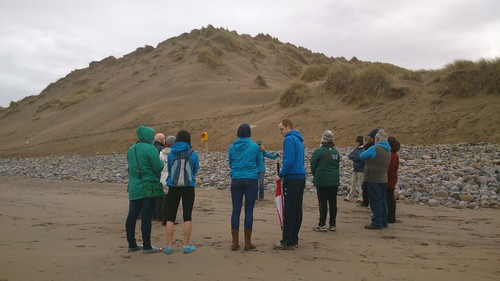
On Saturday, we assembled at 8.15am, by the canon on the Strandhill promenade. The wind coming in from the ocean certainly banished the sleep from our eyes, and we were eager to get moving to warm ourselves up! Auriel began with a brief history of Strandhill village. Where the popular Shells café and Voya seaweed baths now stand, there was once nothing but sand dunes here, until the close of the 18th century.
We made our way down to the main beach. Along the way we heard about the coastal erosion of the beach, and spied for fossils amongst the rocks on the shore, relics of the 350 million year old sea bed from which they came. Auriel then guided us into the dunes of Strandhill, down to the Shelly 'valley', a large area amongst the dunes, sheltered from the wind, with millions of shells underfoot, blown down from the grasses of the dunes, that serve as a rich food source for all sorts of wildlife.
Auriel transported us back to the Ice Age, where in the shadow of Knocknarea, we learnt about how the landscape was forever altered by the path of glaciers. Our (Paleolithic) hunter-gatherer ancestors settled here for the rich sources of trout and shellfish. As they lived in huts, little evidence of how they lived day-to-day survives. Dotted along the mountains that surround Sligo, are the highest concentration of megalithic tombs in the world, and the second oldest megalithic tomb in Europe. There's was so much to take in that I couldn't repeat it all verbatim, you'd have to be there!

Photo via Shells Cafe
At 9.30am we returned for a 'walkers' breakfast at Shells Cafe, there was home made scones, jams, muesli, and orange juice served with freshly brewed coffee.
SeaTrails offers locals and tourists the opportunity to lean more about the nature and archaeology of the environment which we co-habit with hundreds of wildlife. Learning why certain things are the way they are in our landscape, from such an educated and enthusiastic guide was a great start to the long weekend. SeaTrails have a whole range of tours around Sligo, and also take group bookings. Visit their website to find out more.

Afterward we popped into the Sligo Farmer's Market, which also runs on Saturday, selling fresh and organic produce for your Saturday and Sunday lunches!

A new initative has recently begun in Sligo. Open Door Sligo appears quite covert, mainly because their facebook page is updated sporadically. The idea is similar to the Open Doors weekend, building of historical significance are opened to the public for an afternoon.
Advance booking is necessary, as space can be limited in some of these buildings. Open Door Sligo had co-ordinated a tour of Sligo's Masonic Lodge last year, and I was disappointed to have missed out, but now I had my chance! Masonic Lodges have always been a source of fascination to most people. Unlike churches and places of worship they remain closed places, accessible only to those who are members of the mysterious brotherhood. Some famous (and unexpected) Freemasons include Oscar Wilde, Clark Gable, Robert Burns, Walter Scott and Peter Sellers.


When we were all seated in the meeting room (where certain decorative features are modelled after the Temple of Solomon), we were given an overview of the Freemasons, and its history in Ireland, by Morgan McCreadie. Morgan is the assistant to the grand secretary of the Irish Freemasons. I had encountered Morgan before, when he spoke at the last Trailblaze event at Dublin's Masonic Temple. He is a most engaging and charismatic individual, and he did succeed in dispelling some popular myth around the Freemasons. In fact just yesterday he was featured in an Irish Times article on the subject of Freemasonry.
The house itself is in a state of disrepair, and relies on donations from members to fund repairs. You could say that the house was lacking a "woman's touch", as a few odds and ends were scattered untidily among the photos and paraphernalia. Freemasons meetings are first recorded in Sligo as far back as December 1760, but it wasn't until 1895, after years of tireless fundraising, that a purpose built meeting place was built in Sligo town. Jack and William Butler Yeats maternal grandfather, William Pollexfen was a member of the Sligo Freemasons Guild.
The Masonic Square and Compass, seen here on the front gate, and the clock on the mantlepiece, are recognisable as architect's tools and are used in Masonic ritual as emblems to teach symbolic lessons. No hierarchy exists in the guild, Morgan assured us, these are working men, and these tools allude to that, to the honesty and morality of their work. Freemason's meetings are ritualistic, which sounds somewhat hocus pocus, but really means that they follow a format that has changed since the formation of the brotherhood, which has become ritual.


There are currently 25,000 Freemasons in Ireland today. The Masonic Temple on Molesworth Street is open to the public, within working hours. The Freemasons discretely donate sums of money to various charities, something that is neglected to be mentioned in the press, further enveloping these societies in secrecy.
The elephant in the room, was the question of why women were still excluded from membership. Morgan gave us a simple, straight forward answer, the subtleties of which escape me now. Essentially, men need a place to gather with their fellow man, in an all male environment, men interact differently than in a mixed environment. Women behave differently together, they are multi-taskers, they make plans, men prefer to relax, knowing what to expect, or something to that effect. I was satisfied with his explanation, I have no desire to become part of the organisation, though now some of the secrecy has been removed, it's not as elusive to me as it once was.
Elements of their ritual still fascinate me, as the 'Freemasonry' wiki states "Freemasons use signs (gestures), grips or tokens (handshakes), and words to gain admission to meetings and identify legitimate visitors.", well this myth does hold true, as confirmed by Morgan.
All in all, an afternoon well spent! I'm thrilled to see initiatives like this taking place (this one was hosted by the Sligo Peace and Reconciliation Partnership, which aims to strengthen cross-border relations), arts and culture are underappreciated at local government level, are usually under funded if at all, if the turnout for this event is anything to go by, its doing something worthwhile.
Find out about future Open Door Sligo events via their facebook page.
-
Read more: Deconstructing a few secrets of the Freemasons (The Irish Times, April 30th 2013)

Admiring the view, in my 1950s mouton jacket that I picked up at a vintage fair in Sligo before Christmas!
A couple of weeks ago I was down in Westport over the weekend for a friend's birthday. I hadn't wandered around the town itself (voted best place to live in Ireland in 2012) since I was in my mid-teens and was obliged to climb the reek at Croagh Patrick with my parents on pilgrimage Sunday. Since that observance has faded from my life, Westport remained in my mind as a place where I spent an uncomfortable few hours stumbling upwards and downwards on a rocky mountain face with thousands of others, and ate at a hotel carvery with my family afterward. I always felt a curious mix of guilt and resentment, guilt because as a family we didn't eat out a lot, but I hated carvery food, and have developed a life long aversion to this Irish tradition ever since.


My friend Lara told me of the beauty of Old Head, and true to her word, took me there for a drive on Sunday morning. It's about a half hour drive outside Westport town and there are some quirky houses to be seen on the way! One of the joys of living in Ireland, you can have Sunday rituals where you go for walks in the countryside, to shake off the sleep.
It was a cloudy day so the peak of Croagh Patrick was obscured (see second picture). What I found most breathtaking at Old Head however, was the many different shades of blue I could make out, between the sky, horizon and the sea. There were shades of blue I don't think I've ever seen before, even on afternoons in Italy gazing across the water. It was a still, tranquil landscape, I found it very peaceful there.
We took a walk along the headland. The wood there reaches right down to the water and I think it is one of the only remaining pre-medieval forests in Ireland.

Couldn't mention a party without a party picture!

A restaurant where the patrons can openly complain about the food then?

Sunday afternoon trad session in Matt Molloys
I didn't take any pictures in the town itself, preferring to wander round and peep in boutique windows. I'm hoping to get back some weekend when the weather's warmer. They have some lovely pubs and restaurants, and beautiful boutiques. I have also heard of a café that apparently sells an incredible cup of hot chocolate, and that's always a serious lure for me!