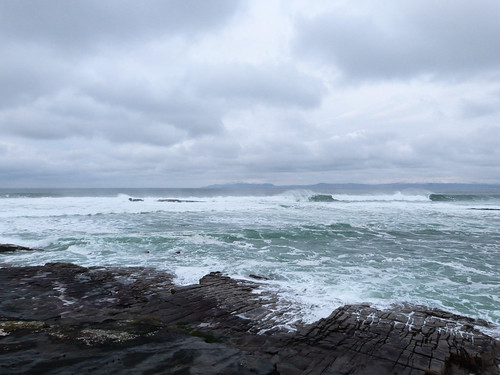
Of all European lands I venture to say that Ireland is the most mystical, and, in the eyes of true Irishmen, as much the Magic Island of Gods and Initiates now as it was when the Sacred Fires flashed from its purple, heather-covered mountain-tops and mysterious round towers, and the Greater Mysteries drew to its hallowed shrines neophytes from the West as well as from the East, from India and Egypt as well as from Atlantis; and Erin's mystic-seeing sons still watch and wait for the relighting of the Fires and the restoration of the old Druidic Mysteries. Herein I but imperfectly echo the mystic message Ireland's seers gave me, a pilgrim to their Sacred Isle. And until this mystic message is interpreted, men cannot discover the secret of Gaelic myth and song in olden or in modern times, they cannot drink at the ever-flowing fountain of Gaelic genius, the perennial source of inspiration which lies behind the new revival of literature and art in Ireland, nor understand the seeming reality of the fairy races.
- W. Y Evans Wentz, The Fairy Faith in Celtic Countries, 1911 (via The Sacred Island)

On the last Friday of January my Dad had a few days off work so I was trying to think of something we could do for the afternoon. I had the idea in my head a few weeks ago that I wanted to climb Carrowkeel, not having done so before. Sligo is richly adorned with remenants of our pre-historic past and I'd like to explore as much of it as I can.
Carrowkeel is a Neolithic (Stone Age) passage tomb cemetery in South County Sligo (I live to the North). The tombs are between 5400 and 5100 years old, so that they predate the Pyramids by 500-800 years. Carrowkeel is one of the big four passage tomb cemeteries in Ireland. This whole area, a good chunk of County Sligo was one of the most important centres of neolithic Ireland. (more info) On a clear day you can see the whole landscape of Sligo, due to its height, and sometimes you can even see as far as Croagh Patrick in Co. Mayo.
There isn't really a 'typical' Irish day, but a great number of them involve grey skies and rain. When we climbed it was a 'typical' Irish day. The mist hung heavy about us, sticking to the wool of my coat and skirt and blurring my vision. I wore a sensible pair of boots, my Dad had his wellies. It was very muddy, but it was only us and the sheep ascending the mountain that afternoon.

My umbrella wasn't quite up to the challenge of Carrowkeel

The only other living things we met on our climb were sheep and rams, like this fellow here


When we got to the summit and alighted by one of the cairns, even though I couldn't witness the famous aerial view of Sligo due to the heavy fog, it did make it all the more atmospheric. It was one of the rare moments that you did genuinely feel like you could be one of the only people on earth, it felt so far removed from civilisation. Though the evidence of past civilisation was there. Looking around, you almost expected to see spectres moving silently through the mist. The mood reminded me of Andrea Arnold's adaption of Wuthering Heights.
Walking downhill was tricky, trying to recall your path through a carpet of thick heather is as difficult as it sounds. The wind whistled in our ears and the mist lay heavy upon us. We plodded through the mud on the way back to the car, we were glad to make it back to the 21st century as we shook the rain off our coats.
It is a pity that the OPW (Office of Public Works) don't provide more information on the site, onsite. However it is quite easy to find, and if you are visiting Sligo, it is a short detour off the main Dublin road into Sligo, and is well sign posted. I hope to make it back during the summer.

Skirt - 1950s St. Michael, made from Yorkshire wool and cashmere; Jumper - 1960s Pringle, Scottish wool. Book - Noblesse Oblige edited by Nancy Mitford and Evelyn Waugh, picked up at the Temple Bar book market a few years ago.
I wrapped up in my woolens for the day. I had just finished reading The Mitfords: Letters Between Six Sisters by Charlotte Mosley (highly recommended!) and my outfit was inspired by the Mitford mood I was in at the time, as well as by necessity!
To warm up, my Dad and I went to 'A Casa Mia' in Sligo town for a treat, before going to see Lincoln in the Gaiety cinema. I blogged about the meal, from a vegetarian point of view, at Sligo Bites.