While I was in London last month I was lucky enough to catch the Pre-Raphaelite exhibition at Tate Britain.
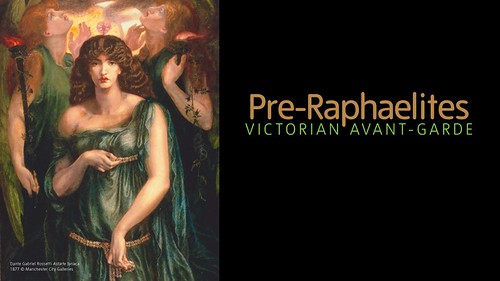
In contrast to previous Pre-Raphaelite surveys, this exhibition juxtaposed paintings with works in other media including the applied arts, showing the important role of the Pre-Raphaelite Brotherhood in the early development of the Arts and Crafts movement and the socialist ideas of the poet, designer and theorist, William Morris (1834-1896). Bringing together furniture and objects designed by Morris‘s firm, of which many Pre-Raphaelite artists were part, the aim was to depict how Morris’s iconography for British socialism ultimately evolved out of Pre-Raphaelitism.
Some of the works I had seen at exhibitions previously. I was thrilled to see more of a female presence at this exhibition, including some previously unseen works by Elizabeth Siddal.
Source
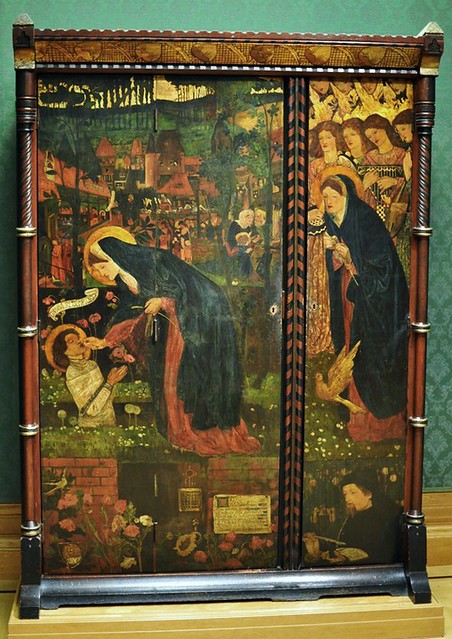
Cabinet Decorated with Scenes from ‘The Prioress’s Tale’, Philip Webb and Edward Burne-Jones. This cabinet, designed by Philip Webb and decorated by Burne-Jones, is made from oak and deal and painted in oil. Burne-Jones gave it to William Morris as a wedding present on his marriage to Jane Burden in 1859. This cabinent stood in the Morris' bedroom at Red House (that I also visited).
It was exciting to see examples of arts and crafts textiles in a Pre-Raphaelite exhibition, showcasing the multi-disciplinary approach of the movement and its followers. I did get emotional over a bed though...

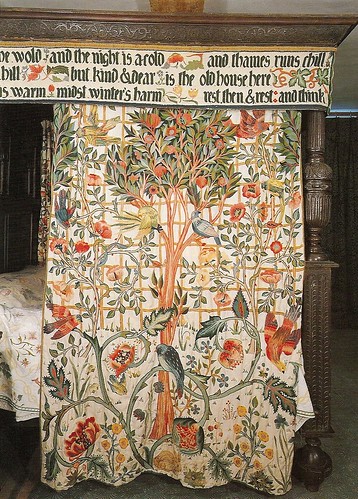
This bed is usually to be found at Kelmscott Manor, the pattern is "Kelmscott Tree" The bed pelmet, in this pattern, was designed by May Morris, and embroidered by Lily Yeats and Ellen Wright (1891-3). Lily Yeats worked for Morris & Co., under May Morris for six years, some of the most difficult years of her life. Her letters to her family mention May and her temper, the difficulty of working for her, frequently referring to her as a "gorgon". For me it was thrilling to look upon something that Lily had probably spent weeks bent over, there's something about the intimacy of a historic textile that really appeals to my senses and emotions.
One of the standouts for me was the female representation in the exhibit, though not significant it's inclusion is necessary. Seeing the women as creative individuals and not just the rigid catalyst for a man's creativity.

Lady Clare, Elizabeth Siddal, 1857.
This drawing illustrates Tennyson's Lady Clare, in which the heroine's natural mother begs her to conceal her humble origin, lest Lord Ronald withdraw his offer of marriage.

Lady Affixing a Pennant to a Knight’s Lance, Elizabeth Siddal, 1856

The Lady of Shalott, Elizabeth Siddal, 1853. This is the 4th version of the Lady of Shalott, and the only one done by a woman. Here, Siddal shows her at the moment she looks out the window. The woman is dressed simply, unadorned and unsexualised, a completely different perspective to the image of the Lady of Shalott we are acquainted with, like the Holman Hunt below.
Some of the above were purchased with assistance from Sir Arthur Du Cros Bt and Sir Otto Beit through the Art Fund in 1916.
The exhibition wasn't simply self-congratulatory, also included was some contemporary satire, courtesy of Florence Claxton (1840-79). Claxton was an English artist and humorist, most notable for her satire on the Pre-Raphaelite movement. She also wrote and illustrated many humorous commentaries on contemporary life.
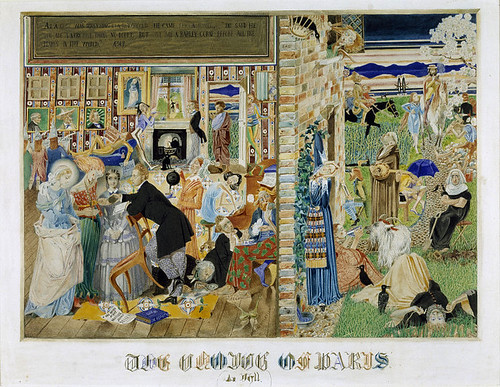
Claxton's The Choice of Paris: An Idyll (c. 1860), a satire on the Pre-Raphaelites. (Click to enlarge)

Isabella and the Pot of Basil, William Holman Hunt, 1868 (completed).
The painting illustrates a poem by John Keats: Isabella, or, the Pot of Basil. In it, Isabella and Lorenzo fall in love. Her brothers kill Lorenzo. After searching for and finding his body, Isabella buries his head under a plant of Basil. Hunt used his wife Fanny as the model. She was pregnant at the time and gave birth to their son in August 1866, but died in December of that year, leaving Hunt to complete the painting after her death. The juxtaposition of the representation of life and death in this painting twinges it with sadness.
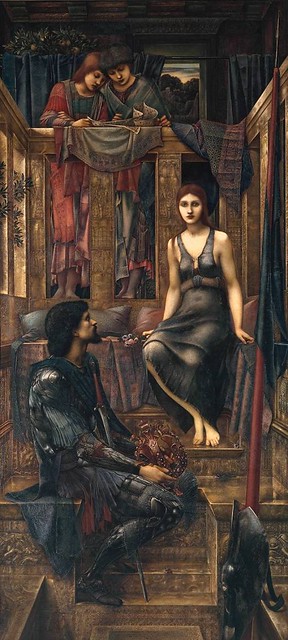
King Cophetua and the Beggar Maid, Edward Burne-Jones, 1884
Taken from a Medieval romance which tells the legend of the prince Cophetua and his unorthodox love for the beggar Penelophon. Cophetua was an African king known for his lack of any natural sexual attraction to women. One day while looking out a palace window he witnesses a young beggar (Penelophon) suffering for lack of clothes. Struck by love at first sight, Cophetua decides that he will either have the beggar as his wife or commit suicide. Obviously Burne-Jones has included a (sheer) sheath of clothing for the sake of Victorian propriety in his depiction of the myth.
This psychedelic depiction of the Lady of Shalott by Holman Hunt was one of the penultimate paintings in the exhibition, it was absolutely stunning in scale and style. Seeing it I experienced one of those magical gallery specific moments where a painting renders you speechless, and in response you can only sit and drink it in.

The Lady of Shalott, William Holman Hunt, (begun in 1886 and finally exhibited in 1905) on loan from the Manchester Art Gallery.
She left the web, she left the loom,
She made three paces through the room,
She saw the water-lily bloom,
She saw the helmet and the plume,
She look'd down to Camelot.
Out flew the web and floated wide;
The mirror crack'd from side to side;
'The curse is come upon me,' cried
The Lady of Shalott.
[Alfred, Lord Tennyson, The Lady of Shalott (1842)]
Some interesting further reading...
Letter from Rossetti to his brother while his “pupil” [Elizabeth Siddal] uses his studio
The Ballad of King Cophetua and the Beggar Maid
Pre-Raphaelitism and Illustration, Florence Claxton
LizzieSiddal.Com
The Pre-Raphaelite Sisterhood
Since being founded in 1977, eva International has gained national and international acclaim, and is recognised as Ireland’s preeminent exhibition of visual art. Previous curators include Brian O'Doherty (1980) and Barrie Cooke, John Kelly, Brian King (1977). 2012's theme "After The Future", curated by Annie Fletcher examines how certain artistic practices provide an active invocation of the present and speculate how we arrived here in the first place. The first eva held in two years, a very successful marketing strategy, has created quite an online buzz around the exhibition, with a regularly updated twitter, that encourages user engagement.
Artists’ projects were selected through an international Open Call for proposals and exhibitions take place in both gallery and non-gallery spaces. A programme of talks, workshops and events accompanies the exhibitions and provides further opportunities for audiences to engage.

Young Model were invited by the organisers to attend the exhibition. Linda Hayden, Assistant Education Curator at The Model and maintainer of the successful Young Model/Young Curators project, invited me to join them on the day. I accepted without hesitation as I was keen to see the exhibition, before it ends on August 12th, and public transport services in the West of Ireland are just as bad as our broadband connection (irregular, delays, etc), so I was doubtful that I would see it at all!
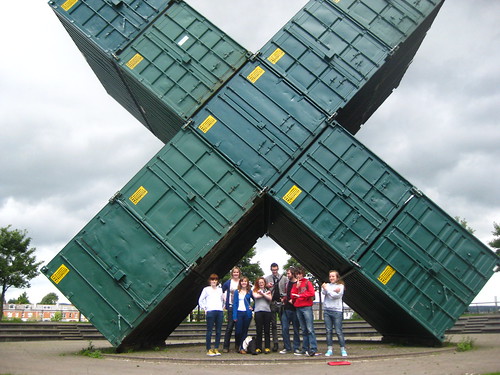
Young Model beneath 'Construction X', Luc Deleu, 1994/2012, made up of 9 shipping containers, in Arthur's Quay Park.
This installation must be the iconic centrepiece of eva, it stands proudly in the centre of Limerick city, probably the most accessible piece of art within the whole exhbition. People have engaged with it in a variety of ways - our guide Aoibheann joked that everyone in Limerick's facebook profile picture features them posing with it! This work was first exhibited at eva 1994, the use of shipping containers alludes to Limerick's industrial past as a busy port. Judging by the streets of Georgian houses, you can imagine that Limerick was once an affluent port city. Currently, it has one of the highest rates of youth employment in Ireland.
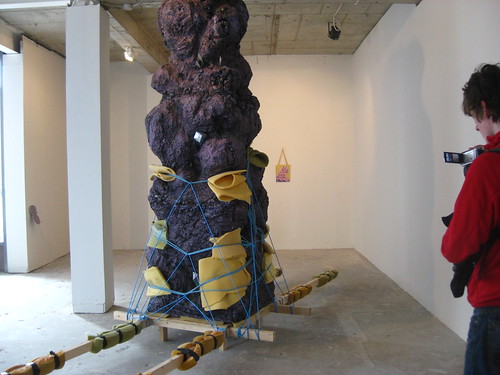
Sam Keogh, 'Monument For Subjects To Come', 2011

Doireann Ní Ghrioghair, 'Ruins', 2012
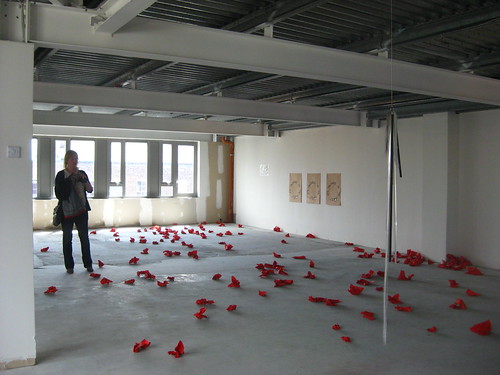
Sanja Iveković's 'Shadow Report' (2012) is perhaps the most distinctive installation at eva, the crumpled, ominous looking sheets of paper are strewn throughout the exhibition, creating an urgent coherency between each space. The Croatia-born artist first created 'Shadow Report' at MoMA, but adapted it for an Irish context.
All the above are exhibited at 103-104 O'Connell St., a NAMA owned building, loaned for the purpose of the exhibition (you can see the unfinished walls in the background of these pictures), and it hoped that this space can be utilized for exhibitions in the long term, rather than reverting back to the disused state they were previously, a concrete legacy of the economic downturn Ireland is continuing to experience.
There was too much to squeeze into our brief visit but we did manage to head down to Faber Studios, an artist collective run from what I believe used to be a former hardware store. Their project 're-possession' promotes the value of reuse and a culture of exchange in the community. Re-possesion aims to explore "the psychological impact of loss through personal stories (tragedy), the methodical documentation of objects (taking inventory), and the rehabilitation of the object by the craftsperson (resurrection)"... more information can be found here.
They have opened a temporary workshop in Faber Studios, inviting members of the public to create their own objects from the lost and found objects they hold there.
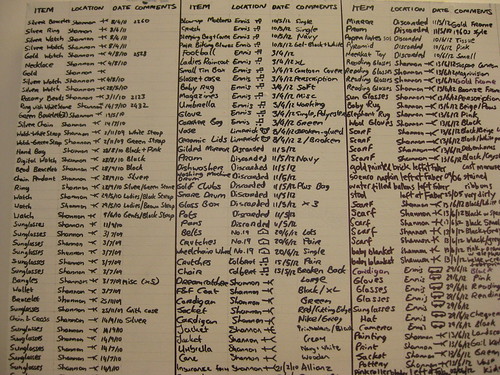
Inventory of lost and found objects at Faber Studios
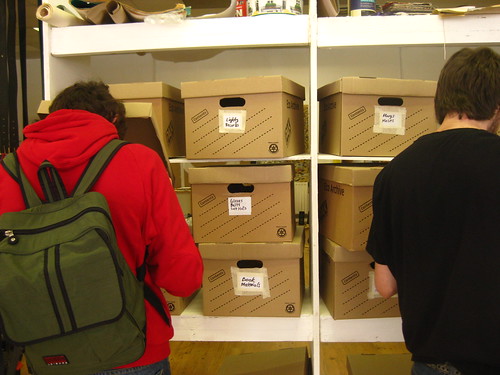
Objects are catalogued individually and stored in categorized boxes, for the public to choose from
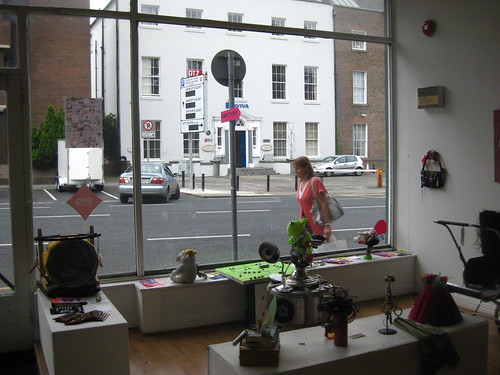
Faber Studios has the advantage of large windows for display of objects and for curious public to look in at the creative folk creating!

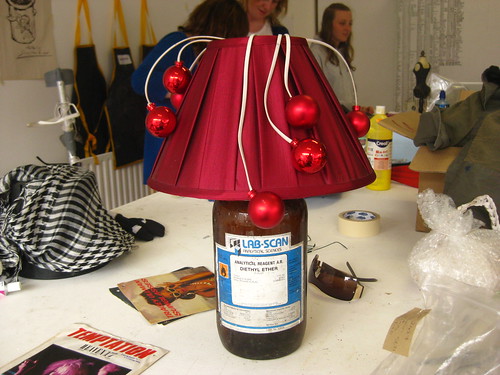
Some of the whimsical objects created by the public who have passed through Faber Studios
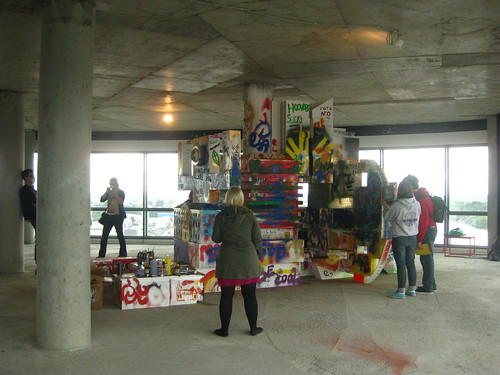
José Carlos Martinat, 'Vandalized Monuments: Power Abstraction 4', 2012
Our final pit stop was up to the 10th floor glass platform of Riverpoint to see this piece by José Carlos Martinat. The visitor was invited to "vandalize" the piece, a challenge we accepted with glee (this piece was pure white at the opening of the exhibition). The structure of the piece challenged questions of power, which are subverted by the audience at the artists' prompting, by "vandalising" this work of art.
One of the installations I found most compelling was Gavin Murphy's video installation entitled 'Something New Under The Sun' (2012). Pivli Takala's 'The Trainee' (2008) captured all our attention, produced in a collaboration with Deloitte and Kiasma Museum of Contemporary Art. For the project, the artist was working for a month as a trainee "Johanna Takala" in the marketing departement of Deloitte where only few people knew the true nature of the project. During the month long intervention an initially normal-seeming marketing trainee starts to apply peculiar working methods, her fellow employees began to act up in response to her behaviour...
I felt invigorated after viewing the exhibition, I hadn't been to an event on such a large scale for a long time. The enthusiasm of everyone involved was infectious, the Director Woodrow Kernohan introduced himself to our group when we arrived and our guide Aoibheann McCarthy, from the Limerick City Museum of Art was patient and attentive throughout the day, which is admirable when dealing with a boisterous group of 16 and 17 year olds.

Yael Bartana, 'And Europe Will Be Stunned', 2010, Limerick City Gallery of Art
It is hoped that the event can become biennial, funding permitting, so all eyes on Limerick, a city evolving and adapting, even through the bad times. We could do with taking some lessons from them.

